Crypto Scalability Trilemma: How New Blockchains Solve the Problem
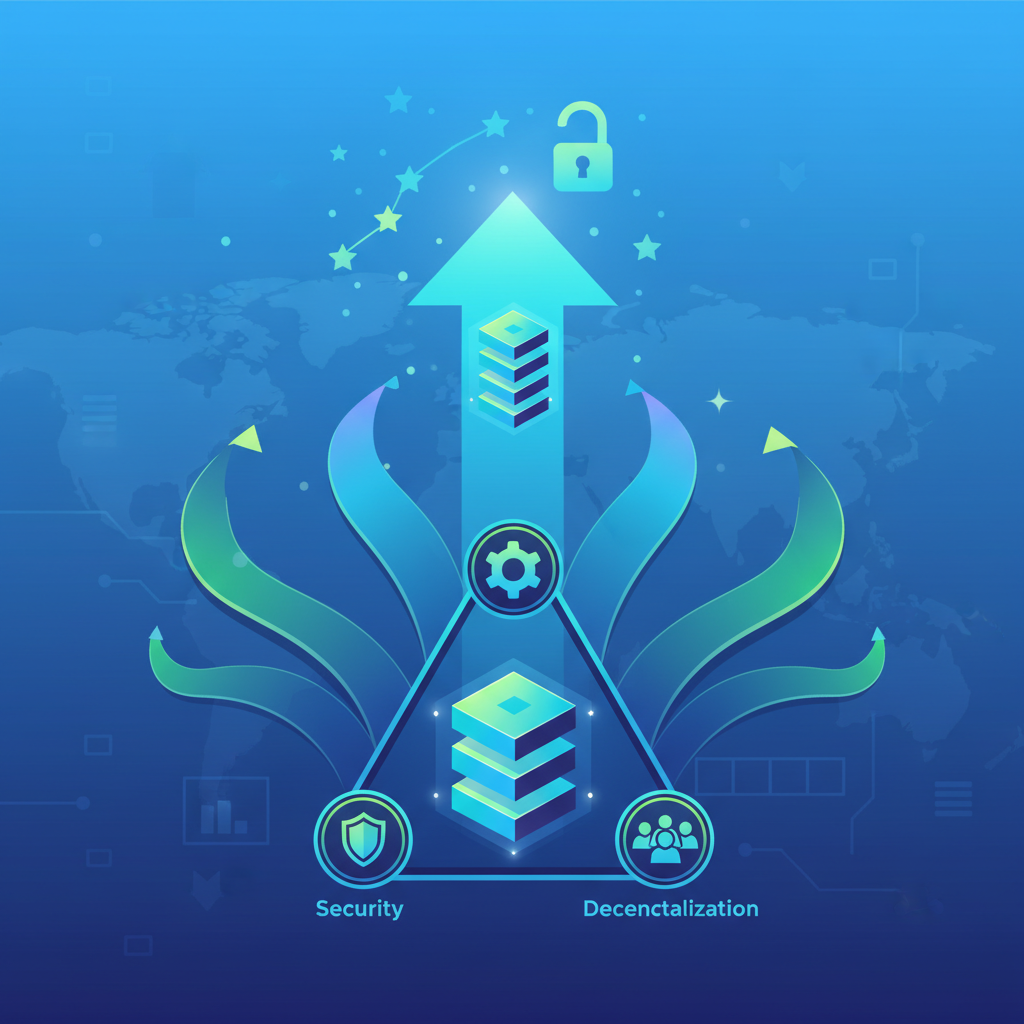
The world of cryptocurrencies is constantly evolving. While Bitcoin sparked the initial revolution, its limitations in transaction speed and scalability have paved the way for new blockchains vying for dominance. One of the biggest challenges these blockchains face is the Crypto Scalability Trilemma, a concept that suggests a blockchain can only achieve two out of three desirable properties: decentralization, security, and scalability.
Understanding the Crypto Scalability Trilemma
The Crypto Scalability Trilemma, often attributed to Vitalik Buterin, the co-founder of Ethereum, highlights the inherent difficulties in building a blockchain that excels in all three crucial aspects:
- Decentralization: This refers to the distribution of power and control across the network. A truly decentralized blockchain is not controlled by a single entity or a small group.
- Security: This encompasses the blockchain’s ability to resist attacks and maintain its integrity. A secure blockchain ensures that transactions are legitimate and data cannot be tampered with.
- Scalability: This relates to the blockchain’s capacity to handle a large volume of transactions quickly and efficiently. A scalable blockchain can process a high number of transactions per second (TPS) without experiencing significant delays or increased costs.
Historically, blockchains like Bitcoin have prioritized decentralization and security, resulting in limitations in scalability. This leads to slow transaction times and higher fees, especially during periods of high network activity.
The Trade-offs in Existing Blockchains
To truly appreciate how new blockchains are tackling the trilemma, it’s helpful to understand the shortcomings of existing solutions:
Bitcoin: Security and Decentralization First
Bitcoin, the original cryptocurrency, emphasizes security and decentralization. Its proof-of-work (PoW) consensus mechanism, while secure, is energy-intensive and slow, resulting in a low TPS (transactions per second) and high transaction fees during peak times. Scalability is definitely not its forte.
Ethereum: A Move Towards Scalability, But Still Under Development
Ethereum, while more flexible than Bitcoin, still faces scalability challenges. While the Ethereum network is moving towards a Proof-of-Stake (PoS) consensus mechanism, the transition has been a long process. The implementation of sharding promises increased scalability but is still under development. The current high gas fees (transaction costs) on the Ethereum network demonstrate that scalability remains a hurdle.
New Blockchains and Innovative Solutions
Several new blockchains are emerging, each with a different approach to solving the Crypto Scalability Trilemma. They are exploring various technologies and architectural designs to improve scalability without sacrificing security or decentralization.
Layer-2 Scaling Solutions
One of the most promising approaches involves Layer-2 scaling solutions. These solutions operate on top of an existing Layer-1 blockchain (like Bitcoin or Ethereum) to handle transactions off-chain. By processing transactions outside the main blockchain, they reduce congestion and increase throughput. Examples include:
- Lightning Network (for Bitcoin): Enables fast, low-cost microtransactions by creating payment channels between users.
- Rollups (for Ethereum): Batch multiple transactions into a single transaction on the main chain, significantly increasing TPS. There are two main types: Optimistic Rollups and ZK-Rollups.
Sharding
Sharding is a technique that divides the blockchain into multiple smaller chains, or “shards.” Each shard can process transactions independently, increasing the overall throughput of the network. This is a complex solution to implement, but it has the potential to significantly improve scalability. Ethereum is working towards implementing sharding in its future upgrades.
Delegated Proof of Stake (DPoS)
DPoS is a consensus mechanism where token holders elect a limited number of delegates to validate transactions and maintain the blockchain. This approach can be more efficient than PoW or PoS, leading to faster transaction times and lower fees. However, DPoS systems may be more centralized than other consensus mechanisms if the elected delegates collude or are controlled by a single entity.
Directed Acyclic Graph (DAG)
Unlike traditional blockchains that use a chain-like structure, DAG-based blockchains use a graph structure where transactions are directly linked to each other. This allows for parallel processing of transactions, potentially leading to higher scalability. IOTA is one example of a blockchain using a DAG architecture.
Algorand: Pure Proof of Stake (PPoS)
Algorand utilizes a Pure Proof-of-Stake (PPoS) consensus mechanism. This approach aims to achieve both scalability and security by allowing all token holders to participate in block creation. It focuses on Byzantine Agreement protocols, where a random selection process ensures security without requiring excessive computational power.
The Future of Blockchain Scalability
The quest to solve the Crypto Scalability Trilemma is ongoing. There is no single, perfect solution, and each approach has its own trade-offs. The most likely future scenario involves a combination of different scaling solutions, each optimized for specific use cases. For instance, Layer-2 solutions may be used for high-frequency microtransactions, while sharding may be used for applications requiring high throughput. The development of more efficient consensus mechanisms, such as Algorand’s PPoS, also plays a crucial role.
Ultimately, the success of any blockchain will depend on its ability to strike the right balance between decentralization, security, and scalability. As the cryptocurrency landscape matures, we can expect to see further innovation and experimentation in this area.
The Impact on Real-World Applications
Addressing the Crypto Scalability Trilemma isn’t just about technical improvements; it’s essential for the widespread adoption of blockchain technology. Faster transaction speeds and lower fees will make cryptocurrencies more practical for everyday use, enabling applications such as:
- Microtransactions: Enabling small payments for online content, services, and digital goods.
- Decentralized Finance (DeFi): Facilitating more complex financial transactions on-chain, such as lending, borrowing, and trading.
- Supply Chain Management: Tracking goods and products more efficiently and transparently.
- Gaming and NFTs: Supporting in-game economies and the secure transfer of digital assets.
Conclusion
The Crypto Scalability Trilemma remains a central challenge for the blockchain industry. While no single solution has emerged as a clear winner, the ongoing research and development efforts are yielding promising results. Layer-2 solutions, sharding, and innovative consensus mechanisms offer potential pathways towards more scalable and efficient blockchains. The continued pursuit of solutions to the trilemma will unlock the full potential of blockchain technology and pave the way for its widespread adoption in various industries.
Ready to dive deeper into the world of blockchain technology? Explore the various scaling solutions mentioned above and stay informed about the latest developments in the field. Start by researching Layer-2 solutions like Lightning Network and Rollups, and explore blockchains like Algorand and IOTA to understand different approaches to the scalability problem. The future of crypto depends on solving this crucial challenge.